Zarco Guerrero
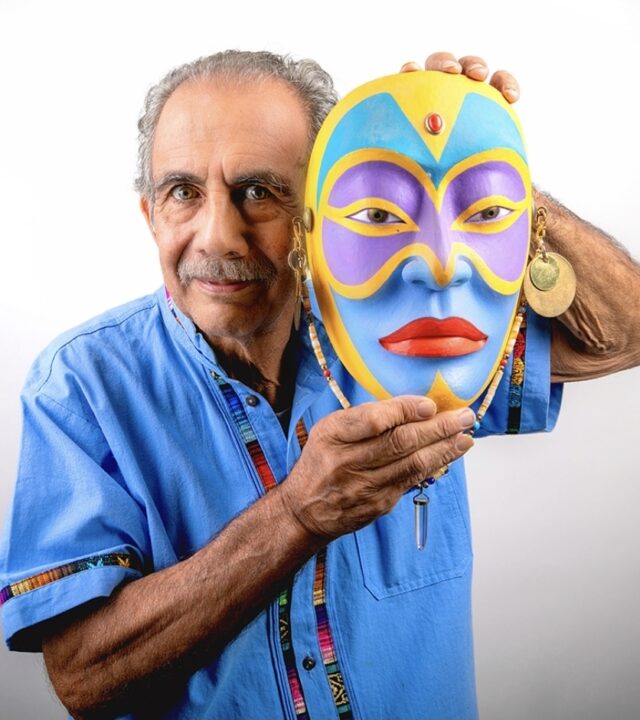
Artistic Director, Zarco Guerrero, is a sculptor, muralist, and performance artist who has dedicated his career to creating positive social change through the arts. Born in Arizona, he has been instrumental in the development of Latino Arts statewide. His art has been exhibited in Mexico and throughout the United States. He has received international acclaim, and awards, such as a National Endowment for the Arts Japan Fellowship, a Governor's Arts Award, a Zony Award, became the Southwest Folklife Alliance Master Artist, and has been awarded grants for artistic projects by The Doris Duke Foundation, Valley Metro and Arizona Community Foundation.
Biography
Zarco has followed in the footsteps of his father, who was a portrait painter and began his artistic career in 1972 when he had his first One-Man Exhibition of bronze sculptures and ceramic masks in Cuernavaca, Mexico. Zarco went to work in the De Aguila Bronze Foundry in order to learn the art of bronze casting. Under the guidance of Mexican master sculptor Francisco Zuñiga, the artist completed a collection of figurative sculptures. The underlying theme of his sculptures was the human condition, particularly the situation of indigenous people in Mexico and Latin America. As a visual artist, he adopted the philosophy of art with a social consciousness and adhered to the ideology of Siqueiros and the Mexican muralists. In Mexico, Zarco formed relationships with mask makers from Tepoztlán and the states of Guerrero and Michoacan. Fascinated by the rich cultural legacy of the mask in Mexico, the artist adopted the mask as an experimental form of sculptural media.
In 1986, Zarco was awarded the Japan Fellowship from the National Endowment for the Arts and lived in Kyoto, Japan. During his residency, he was the personal apprentice of Joshun Fukakusa, a master of the Noh Mask tradition. In 1993, he was awarded the Arizona Governor’s Arts Award for his artistic contributions to the community. He has received the American Association of Hispanics in Higher Education 2010 Award.
Zarco has traveled to Bali, Alaska, Brazil, and China, where he carved ancient archetypes with native carvers. He continues to carve masks in wood, and to perform with his creations. “ I feel that this form of mask performance is unique and extremely effective in reaching large audiences. It has given me the ability to use the power of the mask to transform. With this power, I am able to express my feelings and ideas in many ways that are just not possible with other forms of art like sculpture and painting. I believe it to be my true calling as a contemporary, socially conscious artist. It allows me to work outside the mainstream while contributing to the cultural life of my community”.