Sedona Arts Center: Our Story
Part Two
The Canyon Kiva
Every organization has a beginning. Sometimes it starts with a building, a donation, or a single individual with an ambitious idea.
For Sedona Arts Center, it began with a group of people who believed that art could become an essential part of our community’s future.
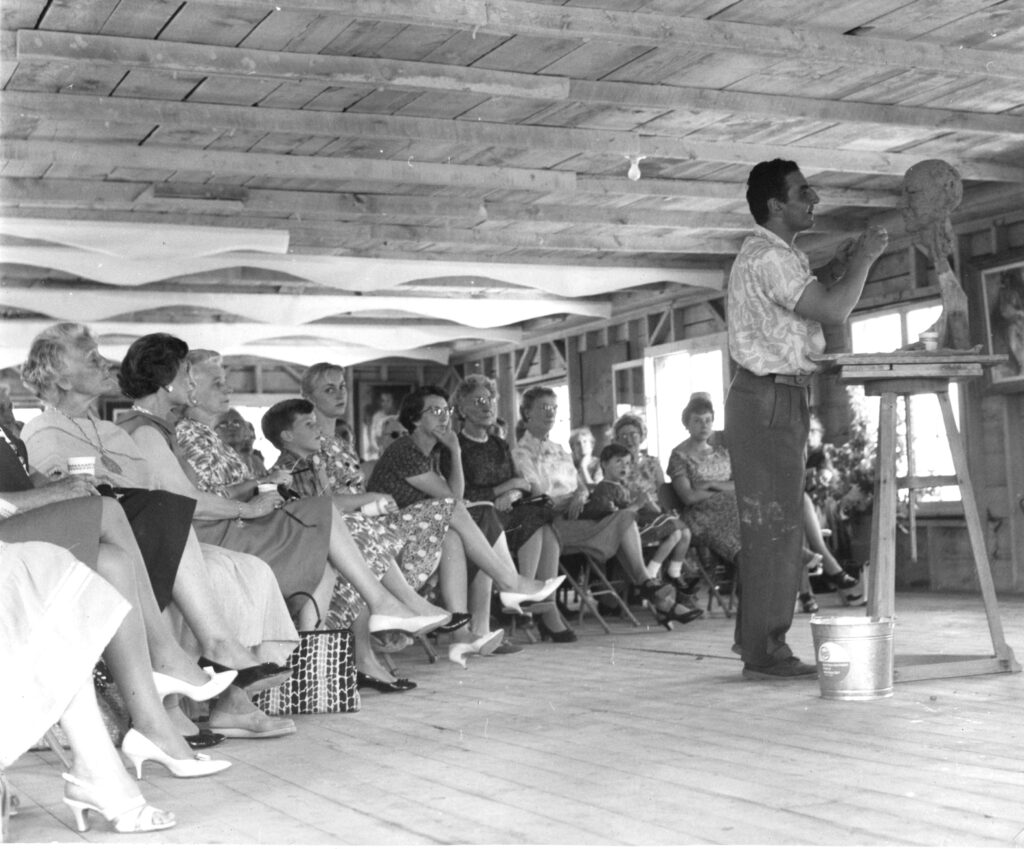
As we explored in Part One, Sedona was already attracting artists, educators, and creative thinkers during the years following World War II. The Sedona Summer Art Center had brought students and professional artists together, creating opportunities for education, exhibitions, and cultural exchange.
But there was still something missing.
A summer program could introduce people to art, bring accomplished instructors to Sedona, and create opportunities for artists and residents to connect. Building something that would last, however, required an organization capable of carrying that work forward.
In 1958, a group of community members took that next step.
They called their organization Canyon Kiva.
A Vision Becomes an Organization
By the late 1950s, Sedona was developing an artistic identity that extended beyond the extraordinary landscape that had attracted so many painters, sculptors, and photographers.
Artists were teaching. Students were learning. Residents were attending exhibitions and lectures. The Sedona Summer Art Center had demonstrated that there was both interest in and support for organized arts education in this small, unincorporated community.
But creating a permanent cultural institution was an entirely different undertaking.
It meant establishing a formal organization, developing a shared purpose, bringing together people with different backgrounds and abilities, and finding the resources to sustain something beyond a single season.
The idea of a permanent cultural center was beginning to take shape.
In 1958, Canyon Kiva was formally incorporated, establishing the organizational foundation for what would eventually become Sedona Arts Center.
It was a significant step forward.
For the first time, the growing effort to establish a lasting center for the arts in Sedona had a formal organization behind it.
And that organization had a name that reflected, perhaps, something of the founders’ hopes for what it might become.
Why Canyon Kiva?
Today, the name Sedona Arts Center is familiar to generations of artists, residents, and visitors.
But our organization began with a very different name.
Canyon Kiva.
A kiva is traditionally a ceremonial space associated with Pueblo peoples of the American Southwest, often serving as a place for gatherings and important communal activities.
We don’t have a documented explanation of why the founders selected the name. Perhaps they were drawn to the idea of a gathering place, somewhere people could come together around a shared purpose.
Whatever their specific reasoning, the organization they established would eventually become exactly that: a place where artists, students, performers, volunteers, and residents could participate in the cultural life of their community.
And in 1958, that vision was beginning to move beyond an idea.
The People Behind Canyon Kiva
The founding of Canyon Kiva brought together thirteen individuals whose names remain part of our organization’s history.
They were Nassan Gobran, E. V. Staude, George Babbitt Jr., Lois Duncan, John Hampton, Willis Leenhouts, Douglas Rigby, Marguerite Staude, Cecil Lockhart-Smith, William W. Stevenson, Helen Varner, Hamilton Warren, and Eugenia Wright.
Their names appear together in our historical records, but they came to the effort from different places within Sedona’s developing community.
Among them was Nassan Gobran, the Egyptian-born artist and educator whose work at Verde Valley School and the Sedona Summer Art Center had already helped establish organized arts education in the area.
Gobran had demonstrated what could happen when professional artists, students, and residents came together to learn and share ideas. His involvement in Canyon Kiva connected those early educational efforts to the creation of a permanent organization.
Hamilton Warren was also associated with Verde Valley School, another connection between the region’s educational community and the developing arts center.
E. V. and Marguerite Staude were among the founding group, as was George Babbitt Jr., whose name is familiar in Northern Arizona’s civic and business history.
Cecil Lockhart-Smith was also associated with the May 1959 Arizona Highways article documenting the Sedona Summer Art Center, providing another connection between the organization and the artistic activities already taking place in the community.
Together, these thirteen individuals brought different experiences and perspectives to a shared vision, helping establish an organization that would become an enduring part of Sedona’s cultural life.
Sedona Arts Center was not created by one person working alone. It emerged through the collective efforts of thirteen individuals who helped establish an organization whose influence would extend far beyond what they could have imagined in 1958.
From a Summer Program to a Permanent Institution
The distinction between the Sedona Summer Art Center and Canyon Kiva is an important one.
The summer program had already shown what arts education could bring to Sedona.
Professional artists traveled to Sedona to teach. Students came for intensive instruction. Residents attended lectures, critiques, and exhibitions. Art was becoming an increasingly shared experience in Sedona, bringing artists and the community together.
And Canyon Kiva represented the next stage in that development.
Its establishment provided a formal structure through which supporters could organize, seek financial assistance, develop programs, and work toward creating a permanent cultural center.
That was no small ambition for Sedona in 1958.
The community was still thirty years away from incorporating as a city. The galleries, festivals, cultural organizations, and arts-related businesses that are familiar today had not yet developed into the extensive creative community we now know.
There was no established Sedona Arts Center campus. There was no Gallery Shop, no dedicated exhibition building, and no Art Barn filled with generations of artistic history.
There was an idea, an organization, and a group of people determined to move forward.
The founders had taken an essential first step. But they still needed something more tangible. They needed a place where the vision could become part of everyday life.
The Beginning of Something Larger
The creation of Canyon Kiva was not the culmination of Sedona’s early artistic development.
It was the beginning of a new chapter.
The organization would eventually expand beyond the educational activities that helped inspire its formation.
Exhibitions would bring artists and audiences together. Theater, music, and dance would become important parts of its programming. Volunteers would raise funds, organize events, help construct facilities, and contribute countless hours to keeping the organization moving forward.
Over time, the Arts Center would become connected not only to Sedona’s artistic identity but also to its civic life.
There would be periods of extraordinary growth, ambitious projects, difficult transitions, and moments when the organization would have to reconsider its direction. But none of that history would have unfolded in quite the same way without the decision made in 1958.
Canyon Kiva gave the effort a formal beginning.
The next challenge was finding a permanent home.
A Place to Call Home
In the years that followed, Canyon Kiva would take another important step toward becoming the Sedona Arts Center we recognize today.
During the 1960s, the organization adopted the name Sedona Arts Center, Inc. And an unlikely building from Sedona’s agricultural past would become central to its future.
The Jordan family’s former apple packing shed offered the possibility of something the organization had been working toward: a permanent place for artists to teach, create, exhibit, and gather.
The building would be purchased for $35,000, a substantial commitment for a young arts organization.
It would become known as the Art Barn.
And within eight years, the mortgage would be paid off, an achievement important enough that the community celebrated by holding a mortgage-burning ceremony.
We still have a photograph of that moment in our archives.
It’s a remarkable reminder that the buildings and programs we sometimes take for granted today were made possible by people who worked, volunteered, contributed, and believed in what Sedona Arts Center could become.
But that story deserves its own chapter.
For now, we return to 1958. A small community. Thirteen founders. An organization called Canyon Kiva. And a shared belief that art deserved a permanent place in Sedona’s future.
The organization had been established.
Now it needed a home.
Next in Our Story: The Apple Packing Shed That Became an Art Center — how a former Jordan family agricultural building became the Art Barn, the effort to establish a permanent home, and the community that helped make it possible.
Sources
- Arizona Highways, “Sedona Summer Art Center,” May 1959
- Sedona Red Rock News, “Sedona Arts Center Celebrates 60 Years”
- Arizona Highways, “A Legacy of Art in Sedona,” 2016
- Sedona Red Rock News, Historical Archives, August 22, 1984
- Sedona.biz, “Julie Richard to Share History of Sedona Arts Center,” 2024